

Newsletter - Funding a Plan, Not Funding a Delay: Aligning Hotel Operations, Cash and Stakeholder Decisions
Assessing hotel turnaround funding starts with establishing what further support would change—and whether the operating plan can be delivered.
When a hotel’s operating plan no longer matches the cash available to deliver it, rising costs and narrowing margins become more than trading pressures. The question for owners, lenders and operators is whether the plan, available resources and stakeholder expectations can be reconciled into something deliverable, and whether hotel turnaround funding is required.
In my recent article for R3, I explored whether further support funds a credible hotel plan or simply extends the same trading position. Here, we examine the practical alignment needed to turn that distinction into action.
Why alignment in hotel funding matters beyond capital projects
A recent Hospitality Investor article made two useful observations: identifying savings is different from ensuring they reach the P&L, and major capital projects require alignment around debt headroom, liquidity and investment returns.
Our view is broader: alignment matters whenever a hotel’s operating plan, available cash and financial obligations need to work together.
Capital investment and operational discipline need to support the same deliverable plan. That includes pricing, payroll, procurement, maintenance, reporting, and the capacity of the hotel team to deliver the actions agreed.
-
Establish the operating reality
A consistent assessment framework is useful; a standard diagnosis is not. Each hotel behaves differently, even within the same ownership or lender portfolio. Market potential, leakage points, cash flow constraints, and delivery capacity vary widely; each will affect hotel turnaround funding.
The first step is establishing the position clearly:
- Trading performance and market conditions
- Cash flow visibility and liquidity pressure
- Operational leakage and margin erosion
- Constraints affecting delivery
Without this clarity, stakeholders may make decisions based on different versions of the position and fail to address the need for hotel turnaround funding.
-
Test the cash, investment and funding assumptions
Once you understand the operating reality, the next question is whether the plan, the cash, and the obligations genuinely fit together.
A forecast may assume higher room rates, reduced payroll, and deferred essential maintenance. Each assumption may look reasonable in isolation. Together, they may depend on a service level, staffing capacity or asset condition the hotel cannot sustain.
Testing the assumptions means understanding what the plan requires, what cash is available, and what the hotel team can realistically deliver. This is often where the distinction becomes clear between funding a plan and funding a delay.
-
Agree what each party must contribute — and who delivers
Stakeholders may understand the same facts but still want different things. An owner may prioritise retaining the business, an operator may need resources to maintain service, and a lender may require a credible route to repayment.
Alignment does not require every party to have the same objective. It requires a shared understanding of the position, clarity about the constraints, and agreement on the actions each party is prepared to support. When those interests cannot be reconciled, identify it - do not conceal it within an optimistic forecast.
Agreement on responsibilities and resources is an essential step toward making the plan deliverable—and exposing any remaining gaps.
-
Deliver and measure progress
Once actions and responsibilities are agreed, the focus shifts to evidence:
- Are the actions being delivered?
- Is margin improving?
- Is leakage reducing?
- Is cash flow visibility strengthening?
- Is reporting giving stakeholders what they need?
This gives lenders and owners a firmer basis to assess progress and provide further support. Evidence helps distinguish a plan being delivered from additional time without meaningful change.
-
Use the evidence to inform the next decision
Progress should lead to a decision, not simply another reporting cycle. If the agreed actions are working, stakeholders can assess whether continued support or further investment is justified. If they are not, the plan, resources or intended route may need to change.
Further funding may be appropriate. A different route may be needed. The purpose is to establish a credible basis for that decision — not presume the answer.
A practical example
At a coastal holiday‑let estate in receivership, Assured Hotels combined an operational reset with revised pricing, wider booking distribution and reforecasting to improve visibility for the receiver and lender.
Following a relaunch from a closed site in May 2026, summer revenue exceeded the prior year by more than £120,000. Improved margins helped cash flow outperform prudent forecasts, creating a buffer for off‑season remedial work and more meaningful Year 2 planning.
Although the asset differs from a hotel portfolio, the case illustrates the connection between operational delivery, cash generation and informed stakeholder decisions.
Read the coastal holiday‑let turnaround case study -> Coastal Holiday‑Let Turnaround | Assured Hotels Case Study
Our role in that alignment
Independent operational support connects the hotel’s trading reality with the decisions its stakeholders need to make. That means testing the plan, identifying the resources required, supporting delivery and reporting what actually changes.
Discuss a Hotel Situation → Book a Teams Call


HOTEL DEMAND REPORT: Strong 2022, hotel recovery falters
Hotel demand and revenues have been strong in 2022, with an unexpected but welcome return to 2019 levels. Unfortunately, the UK hotel recovery falters in December, finishing the year with uncertainty on top of inflationary pressures and labour concerns.
The UK hospitality industry has weathered the pandemic years well. Despite the forecasted media doom, a steady diet of central support and peaks in demand has left the majority in reasonably good order. Softening revenues at this point is bad timing, combined with cost pressures will present very different challenges. Clearly, businesses will have to fend for themselves much more than during the pandemic years.
Rising costs and overheads, together with labour shortages causing salary increases on top of lockdown legacy issues not addressed, are all putting unprecedented pressure on margins and cash flow. Assured Hotels have continued to offer insight and how-to guides in a series of blogs on our website. We have championed solutions and support, either interpreting central Government initiatives or from our own skill set and resources or our partner networks.
Strong 2022, hotel recovery falters at the last
Hotel demand in the UK grew back quickly to pre-pandemic levels since the start of 2022, with RevPAR generally better than in 2019. Rooms revenue would therefore suggest that hotel performance and length of recovery, in general, has been nowhere near as bad as was forecast. Unfortunately, this strong recovery in 2022 faltered in December, which we have looked at in more detail below.
UK compared to the Rest of the World
Booking Momentum - table below compares daily bookings made as a % of 2019 (red line), looking at the UK against the Global consolidated figure and selected developed economies.
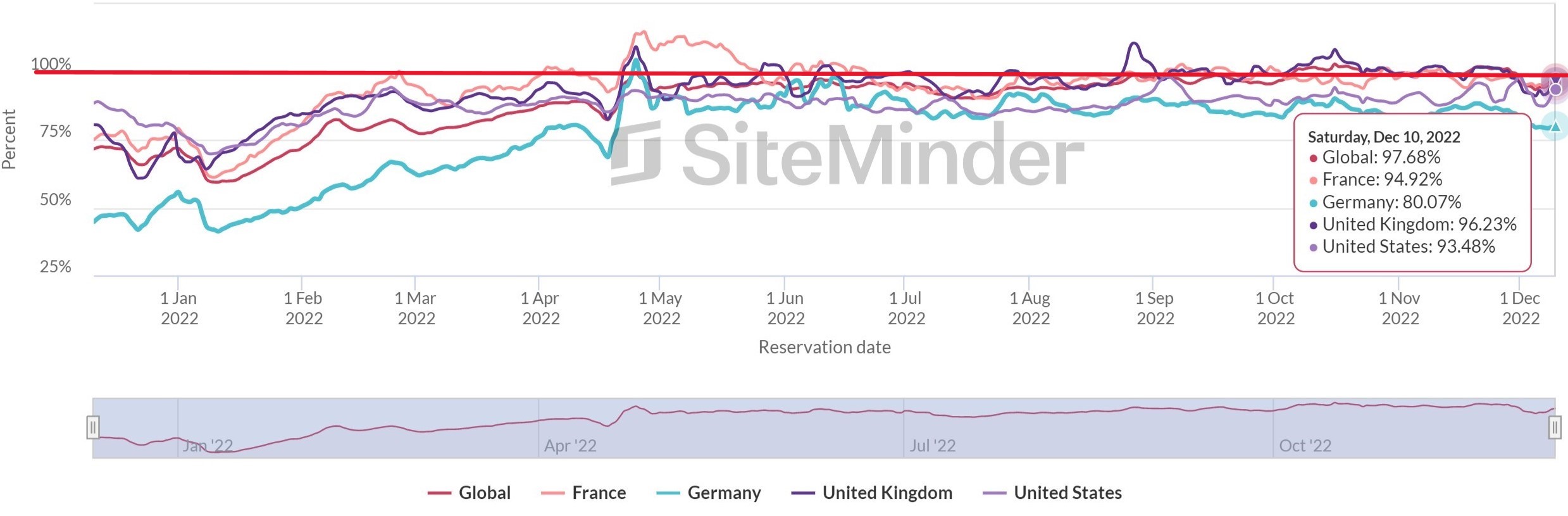
Observations to the 10th Dec include:
Governments change to advice in early 2022, UK overtook and stayed ahead of the Global pace. This led to a spike in May from pent-up demand but was flat over the summer. The UK saw a better recovery compared to Germany, and now performing better than France & US overall.
However a definite softening to demand in December with the UK below 2019 for the first sustained period in 2022. Additionally, this is a very broad national view, we have also looked at the winners and losers in a regional analysis.
UK cities focus; regional disparity with the majority back on 2019
Booking Momentum, regional discrepancies -the table below compares daily bookings made as a % of 2019 (red line), looking at selected cities across the UK.
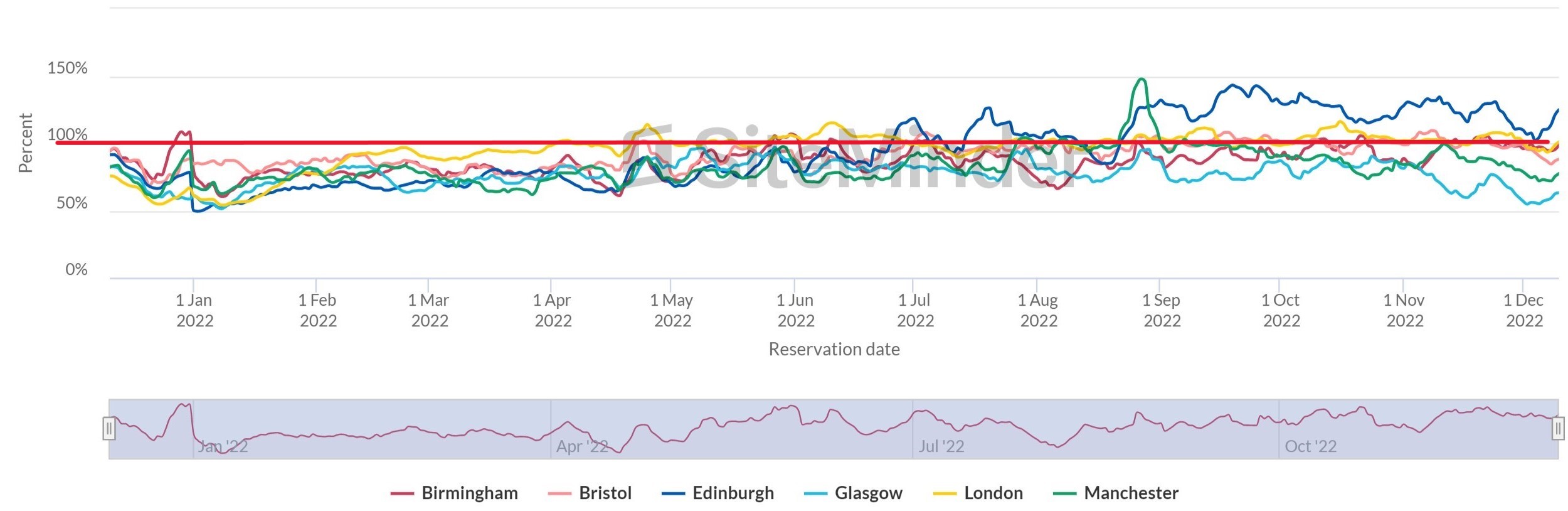
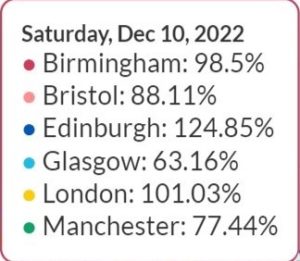
Observations include:
International destinations like Edinburgh & London continue to perform well, driven by pent-up overseas demand - over 30% of all UK hotels booked since April from overseas markets, traditionally under 15% (2020 under 10%). Leisure particularly coastal destinations reliant on domestic markets had an indifferent summer.
Business-reliant cities down on 2019, could be due to working from home and other behaviour changes. Or an indicator of a permanent drop in business mix.
Overall hotel recovery falters as we end the year causing concern to both revenues and margins. A double edge of cost-of-living pressures, hitting not only margins but also discretionary leisure spending.
Softening demand and inflation - Hotel sector the "canary in the mine"?
In summary, we can see the overall trend is a softening to demand, post-Christmas this is poor timing. Positively other data sources suggest room pricing is holding up. On a local level that will need to be assessed carefully as could also quickly come under pressure. Particularly if individual businesses are behind their competitor set, and simply not able to be so bullish on price.
In previous recessions, the hotel sector was always first to see the downturn, the canary in the mine. Revenue and margin regression at the same time as increasing costs means it is then inevitable that the hotel recovery falters. However, this is not terminal as 3rd party support will bring fresh ideas, motivation and improved performance.
Help is at hand.
Assured Hotels offer specialist support to hotel owners and stakeholders, especially in Hotel Advisory and Asset Management capacities. We have been engaged in turnaround and restructuring projects, trading insolvent businesses and in the acquisition or disposal of hotels on behalf of investors.
Please click here to book a meeting, email info@assuredhotels.co.uk or call 0203 916 5658.
Hotel sector occupancy demand report
Flat staycation and rising costs, compounded by an economy in decline.
Welcome to Assured Hotels sector insights blog for the Autumn Winter 2022/23, and we kick off with an updated hotel sector occupancy demand report. We have plenty of other scope with the cost of living crisis and inflation. Additionally, a new PM and cabinet to follow, a certain recession deeper and longer than the last and of course, covid legacy issues yet to be addressed.
We will as always view the glass as half full to identify opportunities, providing insight and live data towards informed decisions and meaningful solutions. So since we updated the report before the summer season, the UK hotel sector hasn’t enjoyed buoyant or expected occupancy levels. This is particularly when compared to covid-affected shorter seasons in 2020 and 2021. Data does suggest that most locations have bounced back towards 2019 levels, however, have we banked enough? The biggest challenge to margins is the risks posed by spiralling costs and the impact on revenues in the months ahead.
The latest trends show the UK continuing to fare well overall using SiteMinder’s World Hotel Index tool:
- UK comparison to a global trajectory and other economies, all largely back towards 2019 volumes however lacking the summer “peak”.
- UK Cities and regions with an international draw buoyed by strong levels of pent-up demand from overseas travellers.
- Uncertain levels of business activity, during the critical autumn, leading up to Christmas.
The next forecast period looks at risk, the economy in reverse will hit consumer and business spending whilst inflation will impact cost of sales, overheads and margins.
UK occupancy compared to the Rest of the World
Booking Momentum – very broad numbers show the UK roughly back to 2019 but disappointingly flat across the peak season
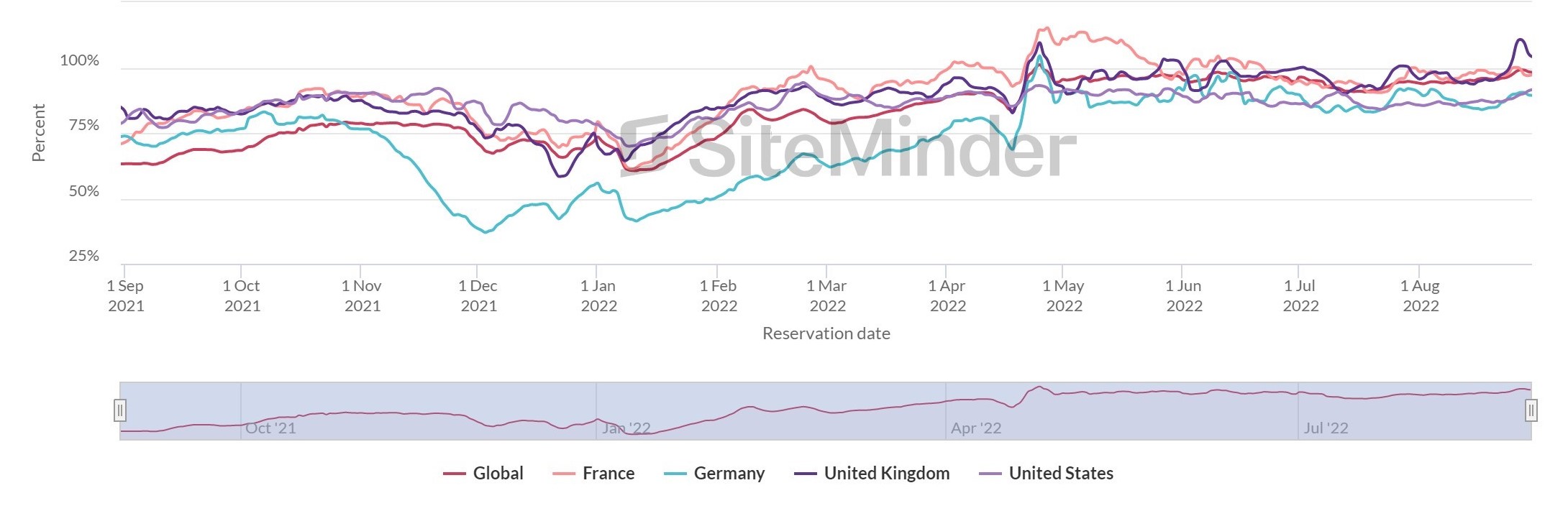
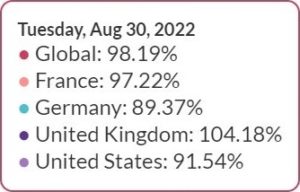
Observations from the summer season to Friday 26th August:
- Governments change to advice in early 2022, UK's daily pace overtook and stayed ahead of the Global demand.
- Bounce in May from pent-up demand but softened since – the reverse of expected seasonal growth with no peak.
- Better bounce than Germany, with a slightly larger population, similarly strong domestic business market but with less leisure. Now also performing better than France & US overall.
- However, this is a very broad one-dimensional view. Further skewed by lots of hotels still closed or used for other purposes, with winners and losers regionally and locally.
UK Hotel sector occupancy, regional disparity continues
Booking Momentum by City - the table below compares daily bookings made as a % of 2019 volumes, comparing momentum across a section of different UK destinations.
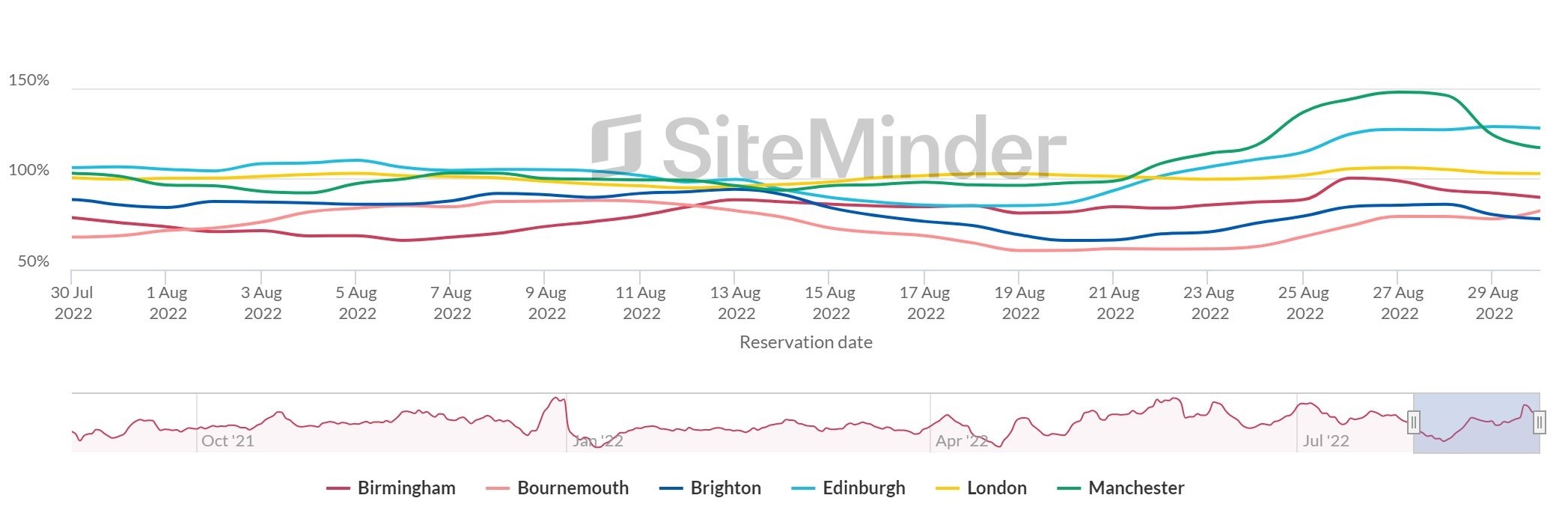
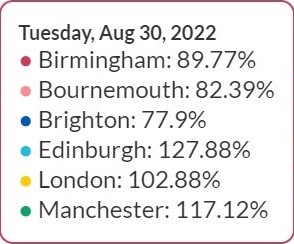
Observations: a mixed bag across different regions, Cities with international appeal perform better:
- London and Edinburgh have performed well over the summer driven by pent-up demand from international travel. This will level out as summer ends, will the business traveller volumes return?
- 34% of all UK hotels booked in June were overseas visitors, 31% in July (in 2020 11.7% & 8.5% respectively). International volumes between 5 & 8% up on 2019.
- Regional cities are mostly still behind 2019, even Birmingham only 80% of 2019 during Commonwealth Games.
- Leisure, particularly coastal destinations have struggled, particularly when compared to strong staycations in 2020/ 21. Brighton circa 70% and Bournemouth only 60% of 2019 during high season weeks. Last-minute staycation cancellations are likely a factor, with a good volume of Brits preferring to go abroad.
- Demand now tailing off as the summer holidays draw to a close, will the business markets return in the numbers required?
Inflation pressures hitting revenues and margins
There is no denying that spiralling inflation is now the biggest threat but not just on cost increases. This will hit hotel spending from consumer and business markets, creating a double attack on margins. This is at a time when many businesses were still grappling with increased borrowing and deferred liabilities from 2020/21. Forecasts will therefore need to be accurate and growth actions more creative than ever.
Despite the gloom and doom, there is still plenty of opportunities to mitigate these risks. So in the coming months, we will be issuing insights and support solutions as the hotel and wider hospitality sector start to navigate this critical phase into a very difficult 2023.
Welcome to Assured Hotels
Assured Hotels have launched a new website detailing how we offer specialist support to hotel owners and stakeholders, in Hotel Advisory and Asset Management capacities. We have been engaged in hotel turnaround and restructuring, trading insolvent businesses and the acquisition or disposal of hotels on behalf of investors.
We maintain impartiality and independence free of any fixed portfolio, offering support services across all disciplines. This includes sales and revenue growth, marketing, finance and reporting, procurement, and compliance. Our flexible contracting ensures affordability, emphasising the development of the hotel's senior management team and therefore better returns for investors and stakeholders.
Please click here to book a meeting, email mgriffin@assuredhotels.co.uk or call 0203 916 5658.

DEMAND REPORT: Hotel occupancy recovery continues, while profit risks deepen
March/ April 2022
Since our last demand update report in February, the UK hotel sector has enjoyed consistent occupancy and revenue growth as Q1 draws to a close. However, since that time the world has faced an equal threat to covid, and our recovery is now exposed to different risks, mostly related to protecting profit margins.
Firstly, an update of the current UK performance compared to other similar size economies shows we are continuing to fare well using SiteMinder’s World Hotel Index tool:
- UK is tracking 10% behind March 2020 occupancy, good news if we look back to the opposite end of the graphic and where we were in April ’21.
- UK Cities achieved mixed progress across the regions, London buoyed by a strong return of international travellers.
- Booking momentum mix, with international travellers making up a third of UK hotel bookings currently at 28.6%, March 2020 as the lockdown started this was less than 20%.
UK compared to the Rest of the World.
Booking Momentum – broad numbers show the UK only 10% down on traditional spring demand
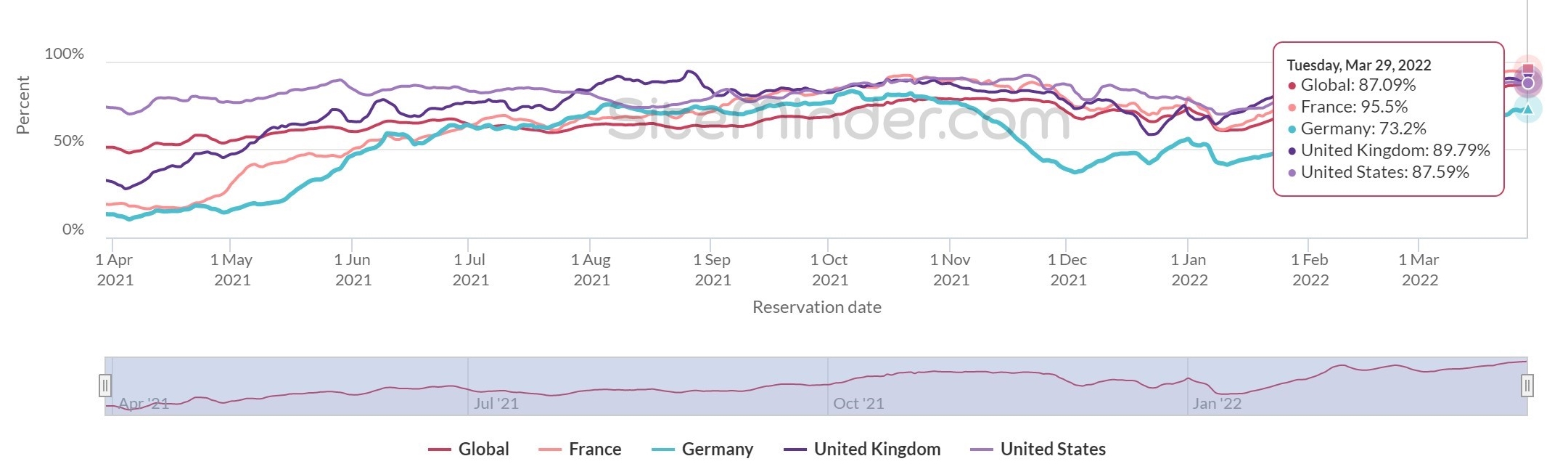 Observations: in isolation this suggests a strong recovery getting towards pre-covid occupancies, however we need to factor other risks to get a full picture for forecasts into Q2 and beyond.
UK cities focus, regional disparity continues
Booking Momentum by City - table below compares daily bookings made as a % of year prior, comparing momentum across a section of different UK destinations.
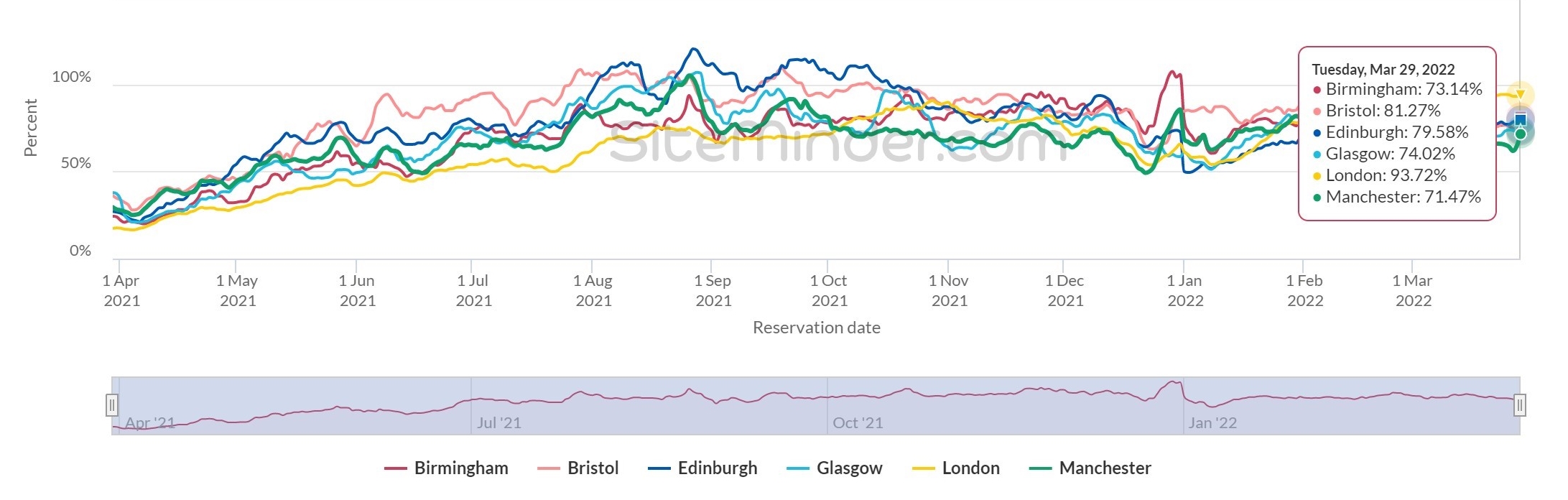
Observations: a mixed bag across different regions, with London leading the pack for the first time, no doubt as a direct result of returning international travel – see below.
Strong return of international travel
Booking Momentum mix - table below compares the mix of UK hotel bookings from domestic and international sources, March 2022 almost 30% of UK hotel bookings when March 2020 was under 20%.
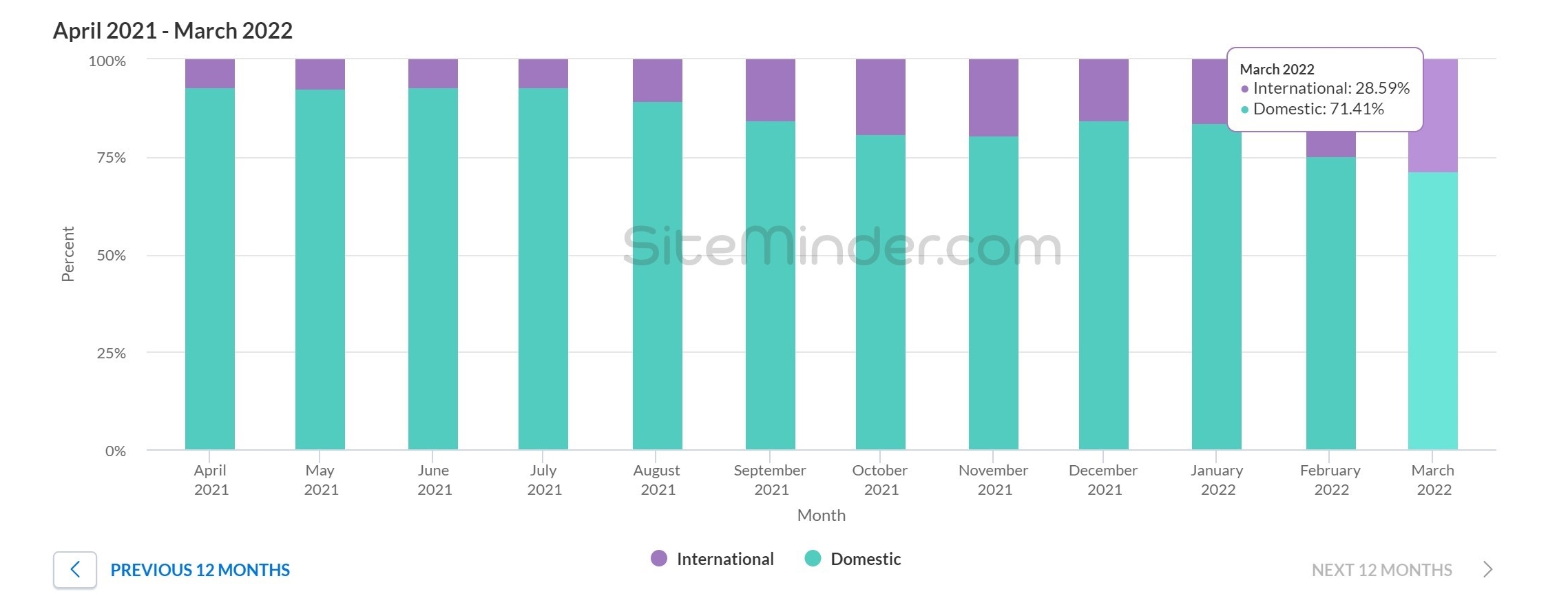
Observations: as we have seen previously as restrictions lift pent up demand is driving higher levels of international travellers, will this sustain for forecasts as we move into the better weather?
So the general trends point to a sustained recovery with volumes growing back towards 2019/20 levels, which is consistent with other data sources, for example, if we look at this article from Hospitality Net with a specific focus on Europe and what looks like very little effect from the situation in Ukraine.
Profit margins at risk
However, there are now other factors to consider as big risks when looking at Q2 forecasts, including:
- Hotel’s re-opening or returning from alternative use – data sets do not include all closed hotels or those used for temporary alternative uses over the past 24 months, businesses must look locally to see if this will dilute expected market share.
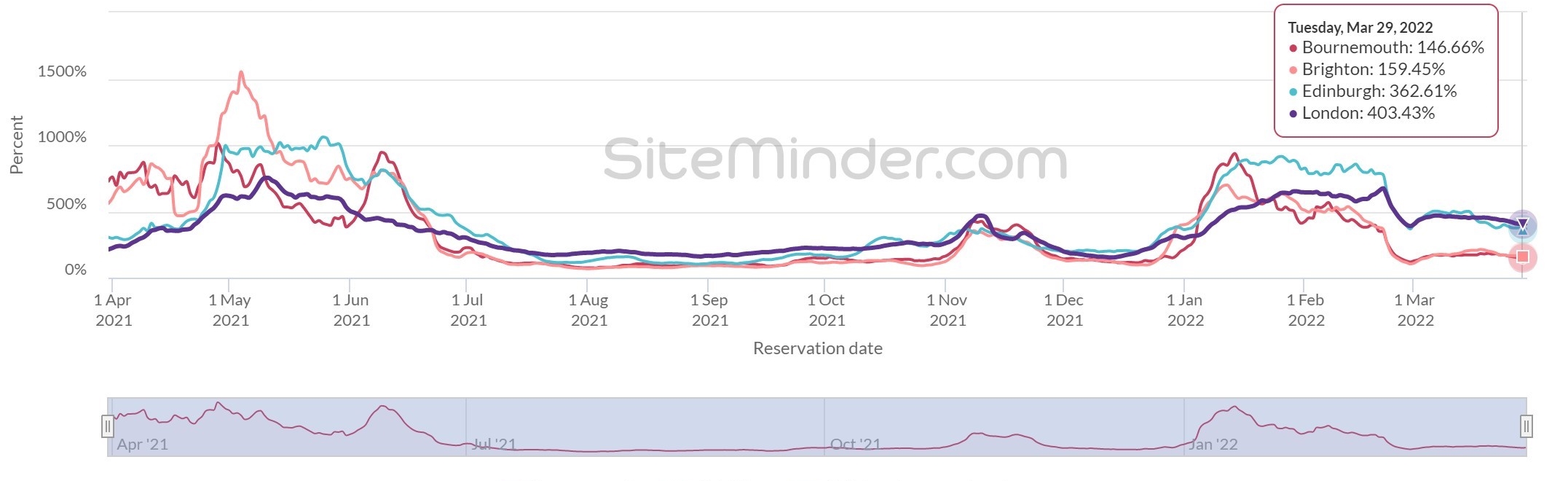
- Staycation 2022 we doubt will live up to 2020 and 2021 now restrictions on air travel have been removed. An early indication is Brighton and Bournemouth in the graphic below, these locations were leading the UK occupancy last year but trends are reversed in 2022.
- Labour shortages continue to limit capacities and increase salary costs just to retain teams and standstill. Additionally, National Minimum wage is set to increase on 1st April which equates to a 6.6% rise across the board if the gap between entry-level employees and supervisory/ junior management is to be retained.
- Covid arrears and forbearance end – the long list of accrued liabilities and arrears will now come into view, including, unpaid taxes to HMRC, unpaid creditors as the moratorium on insolvency ends 31st March, and forbearance on probably higher levels of borrowing and senior debt all need to be addressed.
- Supply pricing – the situation in Eastern Europe has exacerbated winter inflationary pressures, particularly food and general cost of sales items, utilities and fuel which impacts all cost and overhead lines.
- Forecasts therefore will not be straightforward, with capacities and demand uncertain alongside high inflation we are suggesting a need to re-evaluate financial drivers to establish new baseline norms and fully review operational structures and processes.
Assured Hotels have just launched a new website detailing how we offer specialist support to hotel owners and stakeholders, in both Hotel Advisory and Asset Management capacities. We have been engaged in hotel turnaround and restructuring, trading insolvent businesses and in the acquisition or disposal of hotels on behalf of our clients.
We maintain impartiality and independence free of any fixed portfolio, offering support services across all disciplines – sales and revenue growth, marketing, finance and reporting, procurement, and compliance. Our flexible contracting ensures affordability, with emphasis on the development of the hotel’s senior management team and therefore better returns for investors and stakeholders.